Practical
Niagara Falls Weather by Month: The Best Time to Visit, Season by Season
Niagara Falls weather follows the pattern of the eastern Great Lakes: warm, fairly humid summers, long cold winters with heavy snow, and two short, changeable seasons in between. The nearest long-term climate record kept by the National Weather Service is at Buffalo, a short drive from the falls, and its 1991-2020 normals give the shape of the year. July is the warmest month, with an average high of 80.2°F and an average low of 63.1°F. January is the coldest, with an average high of 32.1°F and a low of 19.0°F. About 40.68 inches of rain and melted snow fall in a normal year, spread fairly evenly, and 95.4 inches of snow fall in a normal season.
Weather is only half the question, though. At Niagara the calendar also decides which boats are sailing, which walkways are open, how much water is going over the falls and whether there are fireworks at night. This article goes month by month and season by season, with what the climate record says, what runs when in 2026, and how to pick your dates.
Where the numbers come from
There is no long-term National Weather Service climate station at the falls themselves. The Buffalo office publishes 30-year normals for its three primary stations, Buffalo, Rochester and Watertown, using data from the National Centers for Environmental Information, which it names as the source of record for climate normals. They are recalculated once every 10 years; the current set covers 1991-2020.
Buffalo is the closest of the three to the falls and has the same lake-and-river setting, so it is the figure used throughout this article. Treat the numbers as averages, not forecasts. For the days of your trip, check the forecast a few days ahead.
Niagara Falls weather by month
The table gives Buffalo’s 1991-2020 normal daily high and low, normal precipitation (rain plus melted snow) and normal snowfall, with what is running at the falls in 2026.
| Month | Avg high | Avg low | Precipitation | Snow | At the falls in 2026 |
|---|---|---|---|---|---|
| January | 32.1°F | 19.0°F | 3.35 in | 26.7 in | Maid of the Mist closed; Cave of the Winds and Journey Behind the Falls open |
| February | 33.3°F | 19.5°F | 2.49 in | 18.1 in | As January; the driest month |
| March | 41.8°F | 26.4°F | 2.89 in | 14.1 in | Still winter at the river |
| April | 54.7°F | 36.5°F | 3.37 in | 2.5 in | Maid of the Mist sailed from April 24; daytime falls flow raised from April 1 |
| May | 67.4°F | 48.3°F | 3.37 in | none | Fireworks nightly from May 15 |
| June | 75.6°F | 58.1°F | 3.37 in | none | Boats until 8 p.m. from June 22 |
| July | 80.2°F | 63.1°F | 3.23 in | none | The warmest month; peak season |
| August | 79.0°F | 61.7°F | 3.23 in | none | Warm; boats until 8 p.m. to August 9 |
| September | 72.3°F | 54.5°F | 4.10 in | none | The wettest month; the daytime flow window shortens from September 16 |
| October | 59.6°F | 43.9°F | 4.03 in | 0.9 in | Last fireworks October 12; illumination from 6 p.m. from October 16 |
| November | 47.8°F | 34.2°F | 3.50 in | 7.8 in | Maid of the Mist’s last day November 8; illumination from 4:30 p.m. |
| December | 37.2°F | 25.6°F | 3.75 in | 25.3 in | Winter at the falls; Cave of the Winds still open |
Two things stand out. First, the rain is spread across the year: no month has much less than 2.49 inches, and the wettest months are September and October, not the height of summer. Second, the snow is concentrated from December to February, with January the snowiest month at 26.7 inches. From May to September the normal snowfall is zero.
Mist: you get wet whatever the weather
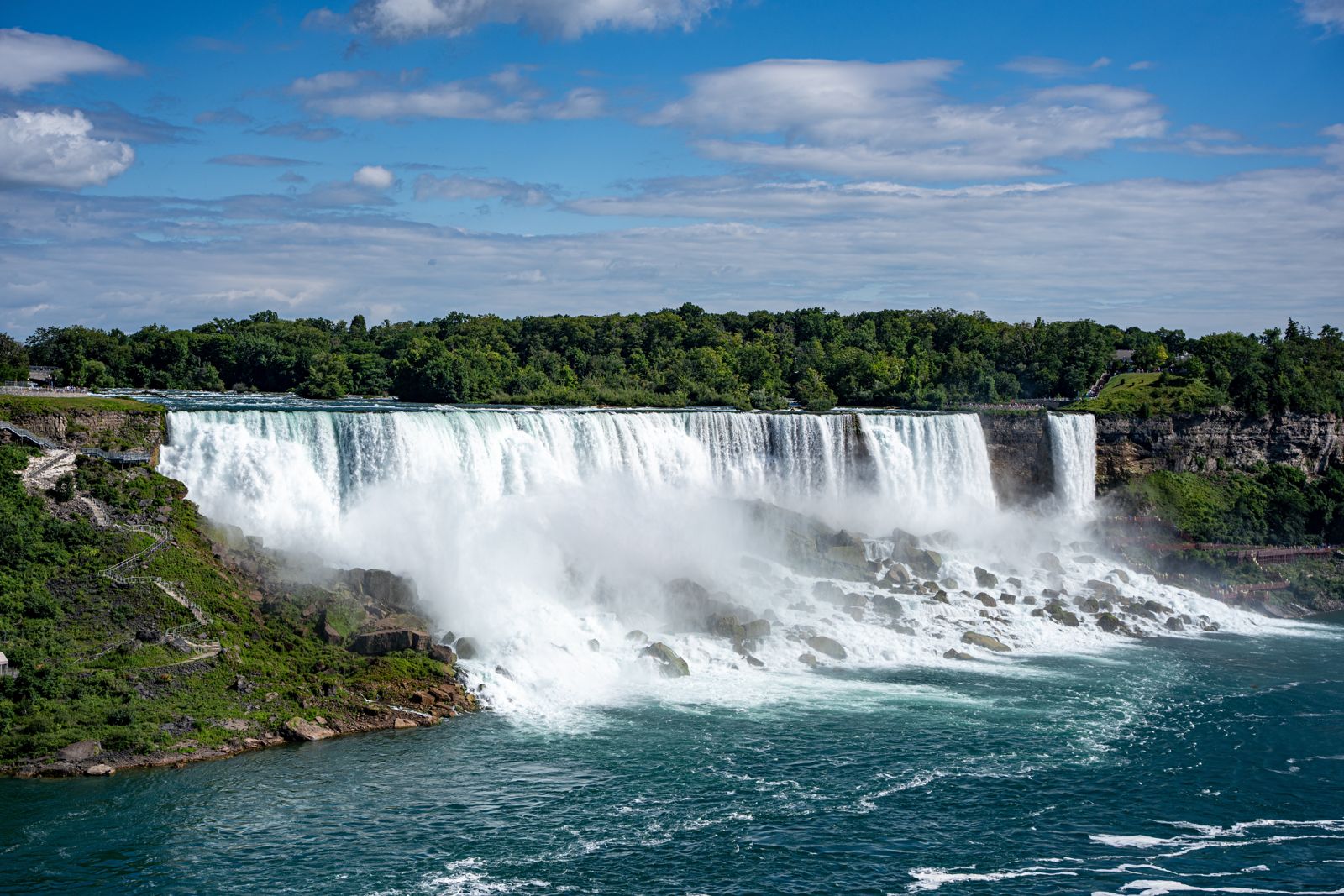
Weather at Niagara has an extra ingredient that no forecast includes: spray. More than 6 million cubic feet of water go over the crest every minute during peak daytime hours, according to Niagara Parks, and much of it comes back up as mist. On a sunny day with a light wind the mist drifts across Goat Island, Prospect Point and the Canadian promenade. It soaks you on the boats and the decks at the bottom of the falls.
That is why the operators hand out rain gear. On the Maid of the Mist every passenger gets a free hooded souvenir poncho, and the company still warns that you may get wet; there is no enclosed section on the boat. At Cave of the Winds, Niagara Falls State Park has stopped giving out the old sandals and asks you to bring footwear you do not mind getting wet. Even in July, a damp T-shirt in the shade of the gorge can feel cold. In spring and fall, when the air is cool, the spray turns a pleasant walk into a chilly one.
What this means in practice:
- Pack a light waterproof layer whatever the season, even on a dry day.
- Wear shoes that can get wet, or carry a spare pair, if you are doing Cave of the Winds.
- Use a dry bag or a zip bag for a phone or camera on the boats.
- Expect wet pavement near the brink, which turns icy in winter.
Summer: June, July and August
Summer is warm rather than hot. The normal high climbs from 75.6°F in June to 80.2°F in July, then eases to 79.0°F in August, with nights in the high 50s and low 60s. Rain arrives as showers and thunderstorms rather than long cold days, at a little over 3 inches a month. In practical terms this is the easiest weather of the year for getting soaked on purpose; a wet poncho dries out fast in the July sun.
It is also when everything is running and the hours are longest. In 2026 the Maid of the Mist sailed daily from 9 a.m. to 8 p.m. from June 22 to August 9, with two 600-passenger boats leaving every 15 minutes. The fireworks run nightly at 10 p.m. through the summer, with extended displays on July 1 and July 4.
The price of summer is crowds. Niagara Falls State Park warns that its lots fill early on weekends, including Fridays, and on holidays, and in 2026 the Prospect Point lot charged $15 from Friday to Sunday between May 22 and October 11, against $10 at other times. If you can, visit midweek and arrive early. For the full list of parking and ticket prices, see our guide to Niagara Falls tickets and prices.
Why the falls are fuller by day in summer
There is one more reason the warm months are the classic time to visit, and it has nothing to do with temperature. Much of the Niagara River is diverted around the falls to the hydroelectric plants on both banks, and a treaty between Canada and the United States, the 1950 Niagara Treaty, sets how much must be left for the view.
During the daylight hours of the tourist season, the flow over the falls must not drop below 100,000 cubic feet per second. Those hours are 8 a.m. to 10 p.m. from April 1 to September 15, and 8 a.m. to 8 p.m. from September 16 to October 31. At all other times, at night and through the winter, the minimum is 50,000 cubic feet per second, half as much. Niagara Parks notes that water is diverted for hydroelectric power after 10 p.m. each night. Niagara Falls State Park puts it simply: the flow is reduced at night so that more water reaches the power intakes, and the falls look their best in prime viewing hours.
So if you want to see Niagara at full treaty flow, go in daylight between April and October. In winter the falls still run, and still impress, but they carry less water than on a summer afternoon.
Spring: March, April and May
Spring at Niagara arrives late. March is still a winter month, with a normal high of 41.8°F, a low of 26.4°F and 14.1 inches of snow. April is the true turning point: the normal high reaches 54.7°F and the snow falls away to 2.5 inches. By May the high is 67.4°F, nights are in the high 40s, and normal snowfall is zero.
The attractions follow the ice rather than a fixed date. Niagara Falls State Park says the spring opening of the Maid of the Mist depends on lake ice in Lake Erie. In 2026 the boats were closed from January 1 to April 23 and sailed from April 24, daily from 9 a.m. to 5 p.m. until May 18. Niagara Parks’ White Water Walk and Whirlpool Aero Car on the Canadian side are seasonal attractions that run from April to November. The fireworks season opened on May 15.
The case for spring is that the falls are already on their summer flow from April 1, the crowds are smaller than in July, and the mist is less punishing in the warm days of late May. The case against: April can still be raw, and a cold, wet April day at the bottom of the gorge is hard work.
Fall: September, October and November
September is many people’s favorite month at Niagara, and the averages back it up. The normal high is 72.3°F and the low 54.5°F, close to June’s figures. It is, however, the wettest month of the year at 4.10 inches, with October close behind at 4.03 inches, so pack for showers.
October cools quickly, from a normal high of 59.6°F to 47.8°F in November, and the first snow can fall: 0.9 inches is normal in October and 7.8 inches in November. The season winds down around you. In 2026:
- The fireworks ended on October 12.
- The daytime treaty flow applied to 8 p.m. from September 16, and ended on October 31.
- The Maid of the Mist sailed its last trips on November 8. Its own schedule lists 9 a.m. to 5 p.m. daily from September 28 to October 31, then 9 a.m. to 4 p.m. from November 1 to 8.
- The scenic trolley in the state park runs until November 29.
- Cave of the Winds moved to its lower winter rates on October 19.
Early fall offers summer-like weather with shorter lines; late fall suits travelers who prefer quiet viewpoints to boat rides.
Winter: December, January and February
Winter is the season of extremes at Niagara. The normal high is 37.2°F in December, 32.1°F in January and 33.3°F in February, and nights fall to 19.0°F in January. Snow is heavy: 25.3 inches in a normal December, 26.7 in January and 18.1 in February. Lake-effect snow, which forms when cold air crosses the open water of the Great Lakes, can bring a lot in a short time.
The falls do not stop. Spray freezes on the railings, trees and rocks along the brink, coating the viewpoints in ice. What changes is how close you can get:
- The Maid of the Mist does not sail from November 9 until its opening day the next spring.
- Cave of the Winds is open year-round, daily, but closes on Thanksgiving, Christmas Day and New Year’s Day. From October 19, 2026 to March 31, 2027 it costs $14 for adults and $10 for youth.
- Journey Behind the Falls, on the Canadian side, is open all year; it takes you down 125 feet through tunnels to portals and a deck at the foot of the Horseshoe Falls.
- Niagara Falls State Park itself is open 24 hours a day, seven days a week, year round.
Dress for wind and spray as well as cold, wear boots with grip for the icy paths, and check road conditions before you drive in.
The falls at night, season by season
Whatever the weather, the falls are lit every night of the year from dusk. The lights, LED units in three locations on the Canadian side of the gorge, have been run by the bi-national Niagara Falls Illumination Board since 1925, and the old xenon lamps were replaced by LEDs in 2016.
The start time follows the sunset. For late 2026 the published schedule is 6 p.m. to 2 a.m. from October 16 to 31, and 4:30 p.m. to 2 a.m. from November 1 to December 31. In winter that means you can see the lit falls before dinner. In summer the lights come on later, but the fireworks add a second show.
The 2026 fireworks ran nightly at 10 p.m. from Friday, May 15 to Monday, October 12. They are free to watch. Niagara Parks says they are set off from within the gorge between the American and Horseshoe Falls, and recommends Queen Victoria Park on the Canadian side; on the New York side, Niagara Falls State Park suggests Prospect Point. Every display is weather permitting, and a show can be cancelled in strong winds. If a night out at the falls is the point of your trip, the tours page lists evening tours that include the lights and fireworks.
Rain, storms and bad-weather days
A wet day is not a lost day at Niagara. The Maid of the Mist runs rain or shine, and since you will get wet on board anyway, rain changes little. Cave of the Winds and the Canadian tunnels are designed for spray. What rain does affect is comfort on the long walks between viewpoints, the views from the top of the gorge in low cloud, and the fireworks.
Thunderstorms are the main summer risk. Maid of the Mist states that its rates, schedules and operations can change without notice because of weather conditions or safety, and the other operators say the same of their own schedules. On a stormy afternoon, plan indoor time and keep the outdoor viewpoints for when the storm passes.
When is the best time to visit Niagara Falls?
The honest answer depends on what you want from the trip.
- For everything running and the warmest weather: late June to mid-August. Boats sail until 8 p.m., the fireworks run nightly, and the falls are at full treaty flow all day. Expect the biggest crowds and the highest weekend parking.
- For good weather with fewer people: September, especially the weeks after Labor Day. The averages are close to June’s, every attraction is still open, and the daytime flow still applies; bring a rain layer for the wettest month of the year.
- For a shoulder-season bargain: May or October. Days are cooler and changeable, but lines are shorter. May has the fireworks; October has the early illumination.
- For frozen scenery: January and February. The falls are at their reduced winter flow and the Maid of the Mist is laid up, but the ice is spectacular, Cave of the Winds and Journey Behind the Falls stay open, and the lights come on in the late afternoon.
Whichever season you choose, read the operators’ schedules before you go: opening days move with the ice in spring and with the weather all year. Our guide to getting to Niagara Falls from New York and Toronto covers the journey, and the tours page lists guided visits for every season.
What to pack for Niagara Falls weather
- Summer: light clothes, a rain layer, sunscreen, and shoes that can get wet.
- Spring and fall: layers, a warm fleece or sweater under a waterproof jacket, and a hat for the boats.
- Winter: an insulated waterproof coat, gloves, a hat, boots with good grip, and a spare dry layer if you plan to go down to the river.
- All year: a bag that keeps your phone dry, and a passport if you plan to cross to the Canadian side.
Frequently asked questions
What is the warmest month at Niagara Falls?
July. Buffalo’s 1991-2020 normals give a July average high of 80.2°F and an average low of 63.1°F. August is almost as warm, with a normal high of 79.0°F.
What is the coldest month at Niagara Falls?
January, with a normal high of 32.1°F and a low of 19.0°F at Buffalo. February is only slightly milder.
How much snow does Niagara Falls get?
Buffalo’s normal is 95.4 inches a season, most of it from December to February. January is the snowiest month, with 26.7 inches.
Does it rain a lot at Niagara Falls?
It rains a little in every month: normal precipitation is 40.68 inches a year, from 2.49 inches in February to 4.10 inches in September. Bring a rain layer whatever the season; the spray will wet you anyway.
Is the Maid of the Mist open in winter?
No. In 2026 the boats closed for the season on November 8 and reopen in spring when the lake ice allows; in 2026 they started on April 24. Cave of the Winds and Journey Behind the Falls stay open all year.
Is there more water over the falls in summer?
In daylight, yes. The 1950 Niagara Treaty requires at least 100,000 cubic feet per second in daylight hours from April 1 to October 31, and at least 50,000 at all other times.