Places
Things to Do at Niagara Falls: The Best Sights on Both Sides of the River
Niagara Falls is three waterfalls, not one: the Horseshoe Falls, the American Falls and the small Bridal Veil Falls beside it. They straddle the border between New York and Ontario, and each country has built its own park along its bank. On the New York side, Niagara Falls State Park takes in Prospect Point, Goat Island and the islands in the rapids, and it is open 24 hours a day, every day of the year. On the Canadian side, Niagara Parks runs the riverside parkland, Table Rock at the brink of the Horseshoe Falls and a string of attractions down the gorge.
That makes the list of things to do at Niagara Falls longer than most people expect, and it splits neatly by country. Below are the sights worth your time on each side, from the free viewpoints to the paid attractions that take you behind, below and above the water, with what each is like, how long it takes and when it runs in 2026.
The two sides at a glance
The quick version, if you only have time to read one section:
- New York side: the best places to stand right beside the falls. Prospect Point and the Observation Tower over the American Falls, Goat Island with Terrapin Point above the Horseshoe Falls, Luna Island between the American and Bridal Veil Falls, the Three Sisters Islands in the rapids, Cave of the Winds at the foot of the Bridal Veil Falls, and the Maid of the Mist boat.
- Canadian side: the best views across to the falls. The promenade faces the American Falls and looks straight into the Horseshoe Falls, and the attractions go underground and down into the gorge: Journey Behind the Falls, the Power Station tunnel, White Water Walk and the Whirlpool Aero Car.
If you can, see both. The getting there guide explains how to cross the Rainbow Bridge, on foot or by car, and what to carry; Niagara Parks says U.S. citizens need a valid passport to enter Canada.
Prospect Point and the Observation Tower
Prospect Point is the classic first view on the New York side. It overlooks the American Falls from the edge of the gorge, and it is where the Maid of the Mist boards.
Right beside it, the Observation Tower extends out over the gorge. Niagara Falls State Park says it gives the only panoramic view of all three falls, the American Falls included, from the New York side. Its elevators run down to the boat landing at the bottom of the gorge, and the elevator and deck are open to all visitors; you do not need a boat ticket to use them. The tower is also a good place for birds, since the gorge is an Audubon Important Bird Area: the park lists peregrine falcons, bald eagles and many gull species. In October 2026 the far end of the tower was temporarily closed, with the rest open.
Goat Island: Terrapin Point, Luna Island and Stedman’s Bluff
Goat Island splits the river at the top of the falls, with the American Falls on one side and the Horseshoe Falls on the other. You can walk it from Prospect Point across a short bridge, or ride the park’s scenic trolley, which circles the park about every 30 minutes on a ticket good all day.
Three viewpoints on Goat Island are worth the walk:
- Terrapin Point sits above the Horseshoe Falls, with the rapids rushing to the brink just beside you. Niagara Parks gives the Horseshoe Falls an average drop of 188 feet and a crest about 2,200 feet wide.
- Luna Island stands between the American Falls and the Bridal Veil Falls, above water dropping more than 175 feet into the gorge, and looks straight down onto Cave of the Winds.
- Stedman’s Bluff, home to the Nikola Tesla statue, looks over Luna Island, the Bridal Veil Falls and the American Falls.
All three are free, and the walk between them is short and flat.
The Three Sisters Islands
Upstream of Terrapin Point, wooden walkways and small bridges lead from Goat Island out to the Three Sisters Islands, in the Canadian Rapids. This is the quietest corner of the park and, for many, the most memorable: you stand among the rapids just before the river becomes the falls, with the water racing past at up to 25 mph, the speed Niagara Parks gives for the rapids above the falls. No ticket is needed, and on a summer afternoon it is a welcome break from the crowds at Prospect Point.
Cave of the Winds
Cave of the Winds is the New York side’s other way to the foot of the falls. An elevator takes you from Goat Island down into the gorge, and wooden walkways lead to the Hurricane Deck at the base of the Bridal Veil Falls, close enough to be soaked by the spray.
Practical points from the park:
- It is open year-round, daily, except on Thanksgiving, Christmas Day and New Year’s Day.
- Tickets are timed and sold only in person, at the attraction on Goat Island or at the Welcome Center, not online. The park advises making your reservation one of the first things you do.
- Bring wet-weather footwear. The park no longer hands out sandals.
- It is accessible to the main viewing platform.
From October 19, 2026 to March 31, 2027, admission is $14 for adults and $10 for youth. Our tickets and prices guide has the summer rates.
The Maid of the Mist
The Maid of the Mist has been a fixture at Niagara for more than 150 years. Its double-deck boats leave from the landing below the Observation Tower, pass the American and Bridal Veil Falls and sail into the basin of the Horseshoe Falls, surrounded on three sides by falling water. The ride lasts 20 minutes, every passenger gets a souvenir poncho, and the boats run rain or shine. In 2026 the season ran from April 24 to November 8, and an adult ticket cost $30.25.
The Canadian equivalent, Niagara City Cruises, makes the same trip from the Ontario bank from April to November. Our guide to Niagara Falls boat tours compares the two in detail.
Down into the gorge: the Schoellkopf ruins and the trails
Most visitors never leave the top of the gorge, which is a pity, because the walks below are some of the best free things to do at Niagara.
A free elevator runs down to the site of the Schoellkopf Power Station, once the largest hydroelectric station in the world. It was built in three sections between 1905 and 1924, and on June 7, 1956, at 5 p.m., two-thirds of it collapsed into the river. The remains lie along the gorge wall, and a trail runs from the site along the river. In 2026 the elevator ran May 7 to October 31, from 7:30 a.m. to 5 p.m. daily.
The park and the Niagara Gorge have over five miles of walking and hiking trails, all starting from the Niagara Gorge Trailhead Center. The park grades them:
- Great Gorge Scenic Overlook Trail: easy, about one hour round trip, for any age.
- Upper Great Gorge Trail: easy, about two hours round trip.
- Devil’s Hole Rapids and Giant Rock: moderate, 2.5 hours round trip, minimum age 8.
- Whirlpool Rapids Adventure Trail: challenging, three hours round trip with rock scrambling, minimum age 8.
Guided gorge hikes run from mid-May through October. The park asks hikers to wear sturdy footwear, carry water, stay on marked trails and keep out of the water.
The Whirlpool and Devil’s Hole
Further down the river, the gorge makes a right-angled turn at the Whirlpool, a basin about 1,700 feet long and 1,200 feet wide. On the New York side, the Whirlpool overlook is two miles north of the Schoellkopf site, with free parking and trailheads above Class V rapids. Beyond it, Devil’s Hole has views down the gorge to the Lewiston-Queenston Bridge, and is close to the Power Vista, which the park describes as free and family-friendly. Both are quieter than the falls and worth a stop if you have a car.
Table Rock and Journey Behind the Falls
Cross to Canada and the view changes completely. From the promenade along the Niagara Parkway you look across at the American Falls and straight into the curve of the Horseshoe Falls, and at Table Rock you stand at its brink.
Journey Behind the Falls starts at Table Rock. An elevator takes you down 125 feet into tunnels cut through the bedrock about 130 years ago, to portals that open behind the falling water and to an observation deck at the foot of the Horseshoe Falls. The tunnels are about 8 feet wide and 7 feet tall. Visitors have come down to this spot since 1832, when the first staircase was built into the gorge.
It is open year round and takes about 60 minutes. On Niagara Parks’ price list, adults pay $33 and children aged 3 to 12 pay $21.50, in Canadian dollars. Improvements are planned: a restored historic tunnel with a covered, heated viewing platform in spring 2027, and an upgraded Rainbow Platform in spring 2028, with the attraction open throughout.
The Niagara Parks Power Station and its tunnel
Upriver from Table Rock, Niagara Parks has turned a 115-year-old hydroelectric plant into one of its most interesting attractions. You travel through the old station, then a glass-paneled elevator descends 180 feet to a tunnel that leads to a viewing spot at the river’s edge, at the base of the falls. A single adult ticket costs $33, children $21.50, plus tax. In the evening it is one of the best places to watch the fireworks.
White Water Walk
Downriver, White Water Walk takes you to the edge of the Whirlpool Rapids. An elevator goes down 70 metres to the bottom of the gorge, and a quarter-mile boardwalk follows the shoreline beside Class 6 rapids, with viewing platforms that take you closer to the water. Niagara Parks calls the rapids North America’s largest series of standing waves; the water here moves at up to 30 mph. The gorge wall shows rock layers about 410 million years old.
It is self-guided, takes about 60 minutes and runs seasonally, from April to November. Adults pay $21 and children $13.50; strollers are allowed.
The Whirlpool Aero Car
The Whirlpool Aero Car is the oldest ride at Niagara. Designed by the Spanish engineer Leonardo Torres Quevedo, the cable car with its yellow arch has crossed the gorge since 1916, carrying passengers 3,500 feet over the Whirlpool. Because of the way the river bends, it crosses the international border four times while starting and ending in Canada, so you do not need a passport.
The ride runs seasonally from April to November and takes about 45 minutes. Adults pay $25 and children $16.50. It is not wheelchair accessible: there are 40 steps down to the car and 40 back up, and passengers stand for the crossing.
Gardens, the parkway and Niagara-on-the-Lake
The Canadian side is also a long riverside park. Near the falls, the Floral Showhouse has displayed orchids, succulents and tropical plants for over 60 years, with seasonal flower shows; adult admission is $8.50 plus tax. Further north, the WEGO bus Green Line runs along the Niagara Parkway past the gorge attractions to the Floral Clock, and a connecting shuttle continues into the town of Niagara-on-the-Lake. Niagara Parks passes include at least two days of WEGO travel and the Falls Incline Railway, which links the Fallsview hotel district to Table Rock.
Jet boats on the lower river
For a faster, wetter way to see the gorge, jet boats run up the lower Niagara River into the rapids below the falls. Whirlpool Jet Boat Tours leaves from Lewiston, New York, and from Queenston, Ontario. Its open Wet Jet soaks every seat; riders must be at least 44 inches tall. A Wet Jet seat from Lewiston costs $68.95 plus taxes and fees, and $78.95 from Canada. If you would rather stay dry, the Dry Freedom Jet runs the same rapids under an enclosed glass dome. Our boat tours guide sets out the age and health limits.
Helicopter flights over the falls
The view that shows how the whole place fits together is from the air. Helicopter flights leave from both sides. From New York, Rainbow Air flies out over Goat Island and the American Falls, then into Canadian airspace past the Rainbow Bridge for a panoramic view of all three falls. From Canada, Niagara Helicopters follows the river from the Whirlpool past the Rainbow Bridge and around the curve of the Horseshoe Falls; its tour lasts 12 minutes including boarding, with flights daily from 9 a.m. The tours page lists flights you can book ahead.
Niagara Falls after dark
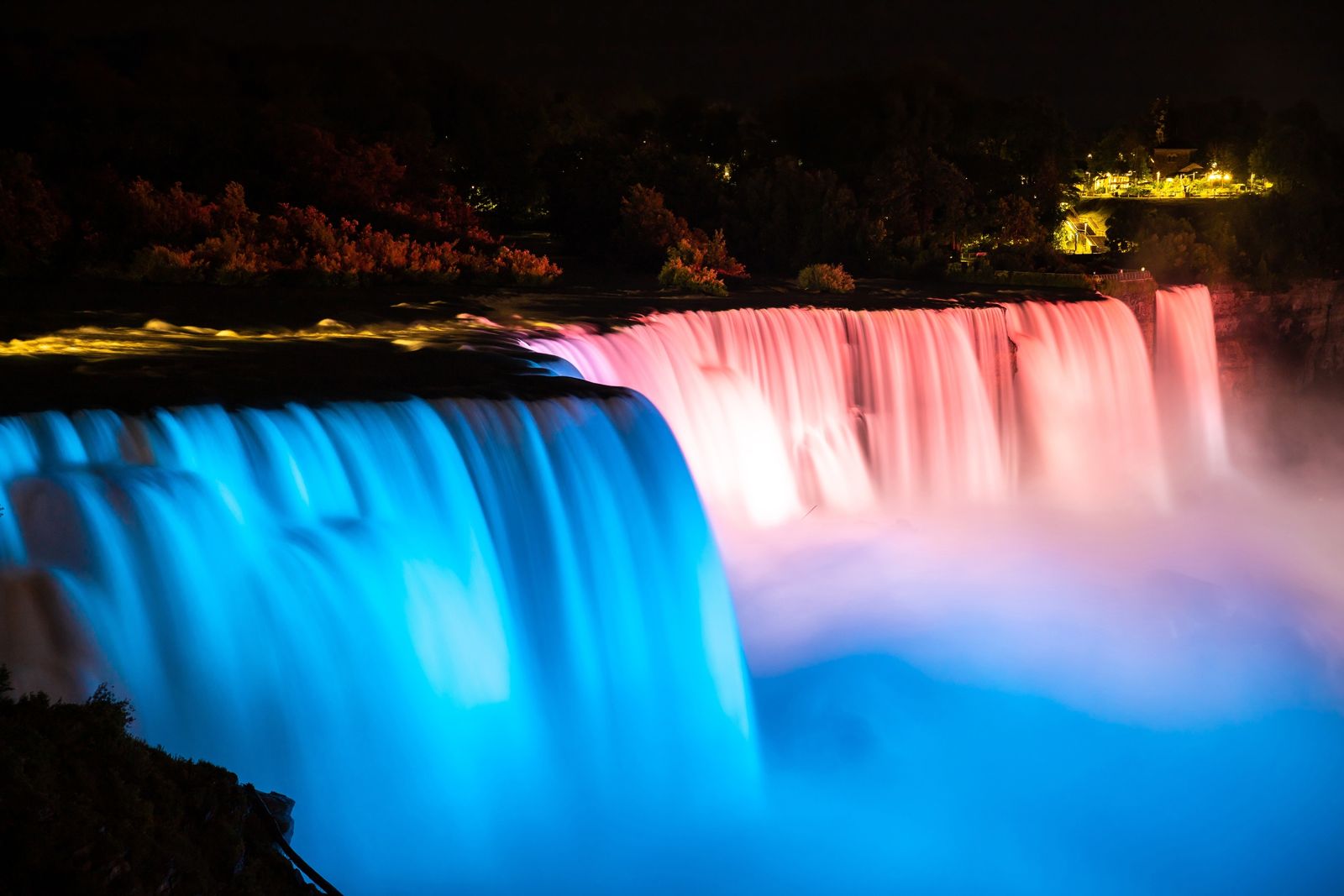
The falls are lit every night of the year from dusk, by lights on the Canadian side of the gorge run by the Niagara Falls Illumination Board since 1925. From late spring to fall there are fireworks too: in 2026 they ran nightly at 10 p.m. from May 15 to October 12, launched from within the gorge between the American and Horseshoe Falls. Both are free.
The best free spots are Queen Victoria Park on the Canadian side, which Niagara Parks recommends, and Prospect Point on the New York side. For something different, Niagara City Cruises runs a Fireworks Cruise after sunset, and Journey Behind the Falls and the Power Station both open in the evening for the show.
Free things to do at Niagara Falls
You can fill a day without buying a ticket. The free list includes:
- Prospect Point and the walk along the brink of the American Falls.
- Goat Island, with Terrapin Point, Luna Island and Stedman’s Bluff.
- The Three Sisters Islands in the upper rapids.
- The Schoellkopf elevator and the gorge trails below it, in season.
- The Whirlpool and Devil’s Hole overlooks.
- The illumination every night, and the fireworks in season.
- The Canadian promenade from the Rainbow Bridge to Table Rock.
What you pay for is parking and the attractions. In 2026 the Prospect Point lot charged $10 a day, rising to $15 from Friday to Sunday in summer; Lot 3 on Goat Island is free on Tuesdays, Wednesdays and Thursdays.
A one-day plan that covers both sides
With one full day, start early on the New York side, when the lots are emptier:
- Morning: Prospect Point and the Observation Tower, then the Maid of the Mist (in season) before the lines build.
- Late morning: book your Cave of the Winds time, and walk Goat Island: Luna Island, Terrapin Point and the Three Sisters Islands while you wait.
- Afternoon: walk across the Rainbow Bridge with your passport and follow the promenade to Table Rock for Journey Behind the Falls.
- Evening: the Power Station tunnel or White Water Walk, then the illumination and, from May to October, the 10 p.m. fireworks from Queen Victoria Park.
Niagara Falls State Park itself says that to see everything in the park you should plan to stay for at least a day, so a two-day trip, one day per side, is more relaxed. Guided tours that combine the boat, Cave of the Winds and the main viewpoints are on the tours page.
Frequently asked questions
What is the number one thing to do at Niagara Falls?
Get close to the water. On the New York side that means the Maid of the Mist or Cave of the Winds; on the Canadian side, Niagara City Cruises or Journey Behind the Falls. Most visitors do one boat and one walk to the base.
Which side of Niagara Falls has more to do?
Both have plenty. The New York side has the best places to stand beside the falls, on Goat Island and the islands in the rapids. The Canadian side has the head-on view of the Horseshoe Falls and more paid attractions in the gorge.
What can you do at Niagara Falls for free?
Walk Prospect Point, Goat Island, Luna Island and the Three Sisters Islands, take the Schoellkopf elevator and the gorge trails in season, and watch the nightly illumination and the summer fireworks.
Do you need a passport for the Whirlpool Aero Car?
No. The Aero Car starts and ends on the Canadian bank, even though it crosses the border four times. You do need a passport to cross from the U.S. into Canada to reach it.
How long do you need at Niagara Falls?
Niagara Falls State Park suggests at least a day to see everything in the park. Allow a second day for the Canadian side and the gorge.